
BOTANICAL NAME: Butea monosperma
FAMILY: Fabaceae
CLASSICAL CLASSIFICATION
Sushruta and Vagbhata – Mushkakadi, Ambashtadi, Nyagrodhadi Gana
Bh. Pr. Ni – Vatadi varga
ENGLISH NAME: Flame of the forest tree
COMMON NAME:
Sanskrit – Kimshuka, Vanaprastha, Tripatra
Hindi – Dhaka
Kannada – Muttuga
Gujarati – Khakhare
Telugu – Modugu
REFERENCE: BHAVAPRAKASH SAMHITA with link e Nighantu:
https://niimh.nic.in/ebooks/e-Nighantu/bhavaprakashanighantu/?mod=read
पलाशः किंशुकः पर्णो यज्ञियो रक्तपुष्पकः |
क्षारश्रेष्ठो वातहरो ब्रह्मवृक्षः समिद्वरः ||
पलाशो दीपनो वृष्यः सरोष्णो व्रणगुल्मजित् |
कषायः कटुकस्तिक्तः स्निग्धो गुदजरोगजित् ||
भग्नसन्धानकृद्दोषग्रहण्यर्शःकृमीन्हरेत् |
तत्पुष्पं स्वादु पाके तु कटु तिक्तं कषायकम् ||
वातलं कफपित्तास्रकृच्छ्रजिद्ग्राहि शीतलम् |
तृड्दाहशमकं वातरक्तकुष्ठहरं परम् ||
फलं लघूष्णं मेहार्शःकृमिवातकफापहम् |
विपाके कटुकं रूक्षं कुष्ठं गुल्मोदरप्रणुत् ||
HABITAT: The tree is found in all parts across India.
BOTANICAL DESCRIPTION:
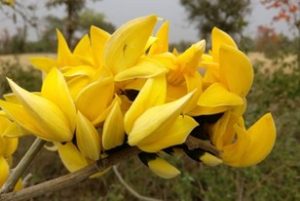
The yellow palash is a rare variety of the deciduous palash tree, characterized by its distinctive pale-yellow flowers rather than the common flame-orange ones. The tree has an erect, medium-sized stature, growing up to 10–15 meters high, with a crooked or tortuous trunk and rough, grayish-brown bark that can peel in vertical strips. Its large, compound leaves are trifoliolate, meaning they have three leaflets, and are shed in the dry season before the flowers bloom. The eye-catching, bright yellow flowers emerge on racemes, or clusters, from leafless branches, with each blossom having a keel petal shaped like a parrot’s beak. Following flowering, the tree produces flat, oblong pods, each containing a single, flat seed.
AYURVEDIC CHARACTERISTICS
| RASA | GUNA | VEERYA | VIPAKA | PRABHAVA | DOSHGHNTA |
Kashaya, Tikta, Katu | Laghu, Ruksha | Ushna | Katu | Kaphapitta shamaka |
AYURVEDIC ENERGETICS
| TASTE | PROPERTY | POTENCY | POST DIGESTIVE ACTION | EFFECT ACTION | DOSHA ACTION |
| Astringent bitter | light dry | Hot | Pungent | Reduces vitiated Kapha and Pitta dosha |
MAJOR CHEMICAL CONSTITUENTS:
Bark and stem of the plant contains kino and tannic acid. Gallic acid is also found in significant amounts. The seeds contain kino oil which is a potent wormicide.
THERAPEUTIC USES:
- Root decoction of Butea monosperma subsides the poisonous effects caused by Bhallataka seeds or oil.
- Bark decoction can be used for wound cleaning, in Hemorrhoids and in Leukorrhea.
USEFUL PART:
Leaf, root
DOSAGE:
Seed powder – 1 -8 g
Decoction – 50 -100 ml
Leaf juice – 10 -20 ml
AYURVEDIC FORMULATION:
- Palasha Kshara
- Palashabeejadi Churna
- Krumimudgara Rasa
- Asanadi Kashayam