
BOTANICAL NAME: Amomum subulatum
FAMILY: Zingiberaceae
CLASSICAL CLASSIFICATION:
Bhavprakash – Karpooradi varga
Dhanvantri Nighantu – Shatapushpadi varga
Raja Nighantu – Pippalyadi varga
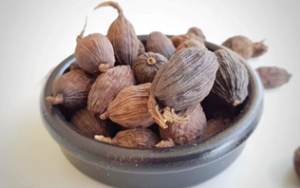
ENGLISH NAME: Black cardamom
COMMON NAME:
Sanskrit – Triputa, divyagandha
Hindi – Badi ilayachi
Kannada – Dodda elakki
Gujarati – Elcha
Tamil – Peria elam
REFERENCE: BHAVAPRAKASH SAMHITA with link e Nighantu:
https://niimh.nic.in/ebooks/e-Nighantu/bhavaprakashanighantu/?mod=read
एला स्थूला च बहुला पृथ्वीका त्रिपुटापि च |
भद्रैला बृहदेला च चन्द्रबाला च निष्कुटिः ||५३||
स्थूलैला कटुका पाके रसे चानलकृल्लघुः |
रूक्षोष्णा श्लेष्मपित्तास्रकण्डूश्वासतृषापहा |
हृल्लासविषबस्त्यास्यशिरोरुग्वमिकासनुत् ||५४||
HABITAT: native to the eastern Himalayas and mostly cultivated in Eastern Nepal, Sikkim, and parts of Darjeeling district in West Bengal of India, and southern Bhutan.
BOTANICAL DESCRIPTION:
Black cardamom is a perennial plant
- Stem
The black cardamom plant has a red stem that can grow up to 12 feet tall, depending on the variety.
- Leaves
The plant has large, glossy, slim, evergreen leaves that grow alternately on clumping stalks.
- Flowers
The plant produces yellow or white flowers that bloom from April onwards. The flowers have a reddish-brown base.
- Fruit
The fruit grows from spikes at the base of the plant. The fruit is a green, three-sided oval capsule that contains 15 to 20 dark, reddish-brown to brownish-black seeds.
- Roots
The black cardamom plant is shallow-rooted, with many lateral and branch roots that run laterally for about 70 to 75 cm.
- Rhizome
The real stem of the plant is the rhizome, which is subterranean (underground).
AYURVEDIC CHARACTERISTICS:
| RASA | GUNA | VEERYA | VIPAKA | PRABHAVA | DOSHGHNTA |
| Katu, tikta | Laghu, Ruksha | Ushna | Katu | Grahi | Kaphavata shamaka |
AYURVEDIC ENERGETICS:
| TASTE | PROPERTY | POTENCY | POST DIGESTIVE EFFECT | EFFECT ACTION | DOSHA ACTION |
| pungent Bitter | Lightdry | Hot | Pungent | Reduces vitiated Kapha and vata dosha |
MAJOR CHEMICAL CONSTITUENTS:
a-terpineol 45%, myrcene 27%, limonene 8%, menthone 6%, ß- phellandrene 3%, 1, 8-cineol 2%, sabinene 2% and heptane 2%.
THERAPEUTIC USES:
- The cold infusion of the seeds of brihad ela is used for gargling to treat diseases of the oral cavity like dental caries, and inflammation of the gums.
- The powder of the seed is given in a dose of 3-5 gm with honey to treat cough.
INDICATIONS:
Kasa (cough, cold), Visha (toxic conditions), Chardi (vomiting), Kandu (itching), Aruchi (anorexia).
USEFUL PART:
Fruit pod/seed
DOSAGE:
Choorna: 1-3 gms
AYURVEDIC FORMULATION:
- Kalyanaka Kashaya choorna
- Sarivadyasava
- Kalyanak ghrita