
BOTANICAL NAME: Gymnema sylvestre
FAMILY: Asclepiadaceae
CLASSICAL CLASSIFICATION:
Bhavprakash – Guduchyadi varga
Dhanvantri Nighantu – Guduchyadi varga
Raja Nighantu – Prabadradi varga
ENGLISH NAME: Cowplant, Australian Cowplant, Gymnema
COMMON NAME:
Sanskrit – Meshashringi, Madhunashini
Hindi – Gurmar, Gudmar
Kannada – Madhunashini
Gujarati – Gudamar, Kavali
Tamil – Shirukurinjan
REFERENCE: BHAVAPRAKASH SAMHITA with link e Nighantu:
https://niimh.nic.in/ebooks/e-Nighantu/bhavaprakashanighantu/?mod=read
मेषशृङ्गी विषाणी स्यान्मेषवल्ल्यजशृङ्गिका |
मेषशृङ्गी रसे तिक्ता वातला श्वासकासहृत् |
रूक्षा पाके कटुस्तिक्ता व्रणश्लेष्माक्षिशूलनुत् ||२१६||
मेषशृङ्गीफलं तिक्तं कुष्ठमेहकफप्रणुत् |
दीपनं स्रंसनं कासकृमिव्रणविषापहम् ||२१७||
HABITAT: This climbing herb grows in tropical areas, native to Asia, Africa, and Australia. But this herb is available throughout India, especially in regions like Uttar Pradesh and Goa.
BOTANICAL DESCRIPTION:
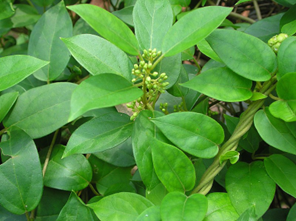
Gurmar is a perennial climbing herb which is covered with weak stem and small hair. The leaves are ovate, and elliptical, with size measuring 3 to 5 cm long. After chewing the leaves, it becomes hard to perceive the sweet taste at least for about 15- 20 minutes. The fruits of this herb grow in January to March. The flowers of this herb are small, pale yellowish green that grows from August to September and the root of this herb is about 3 cm thick.
AYURVEDIC CHARACTERISTICS:
| RASA | GUNA | VEERYA | VIPAKA | PRABHAVA | DOSHGHNTA |
| Kashaya, Tikta | Laghu, Ruksha | Ushna | Katu | – | Kaphavata shamaka |
AYURVEDIC ENERGETICS:
| TASTE | PROPERTY | POTENCY | POST DIGESTIVE EFFECT | EFFECT ACTION | DOSHA ACTION |
| Astringent Bitter | Light Dry | Hot | Pungent | – | Reduces vitiated Kapha and vata dosha |
MAJOR CHEMICAL CONSTITUENTS:
- Gymnemic acids: A highly effective chemical constituent that acts as a cardiovascular stimulant
- Gymnema saponins: A major chemical constituent that is classified as an oleanane saponin
- Gurmarin, Gymnemagenin, Phenols, Flavonoids, Tannins, Triterpenoids
THERAPEUTIC USES:
- Fresh juice of plant increases the appetite and stimulates the liver for better functioning.
- The decoction of the plant is given in a dose of 40-50 ml to treat dysmenorrhea, fever, renal calculi, and difficulty in micturition
INDICATIONS:
Kasa (cough, cold), Visha (toxic conditions), Chardi (vomiting), Vrana (ulcers).
USEFUL PART: Leaf, root
DOSAGE:
Choorna: 5-6 gms
Decoction: 40-80 ml
AYURVEDIC FORMULATION:
- Amritamehari churna
- Glukostat capsule